According to New Jersey’s Motor Vehicle Commission (MVC), “the only scientific way to determine whether a driver is under the influence is through blood alcohol concentration (BAC).” Few legal scholars would dispute that claim. Rather than relying on the subjective interpretations of individual police officers, court cases should be based in hard, scientific evidence.
Unfortunately, New Jersey considers blood testing, the gold standard in determining BAC and impairment, a last resort. Instead, you’ll be told to submit to “a simple Breathalyzer test” after being pulled over.
What Should I Know About Breath Tests?
New Jersey’s drivers are governed by a legal doctrine known as “implied consent.” If you drive in-state, and are lawfully pulled over by an officer who had probable cause to believe that you were intoxicated, you have automatically consented to take a breath test.
You may refuse the test, but this is a violation in itself, with a minimum penalty of license suspension lasting seven months. And refusal doesn’t mean that you’re off the hook for DWI, either. In fact, a refusal can be used as an argument against you, that you refused because you knew you would fail. If you are convicted of both “Refusal To Submit” and DWI, your penalties can double.
You can learn more on our “Refusing A Breath Test” page here.
Is Breath Testing Reliable?
Breath tests are common in America, but their reliability is highly disputed. The machine currently used for breath testing in New Jersey is the Draeger Alcotest 7110 MKIIIC™ machine. We own this machine, and three of our lawyers are certified to operate it.
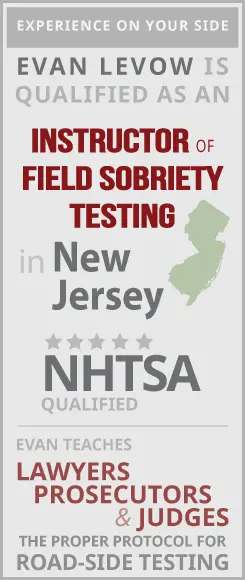
The Alcotest has many pitfalls and possible errors. In fact, our senior partner Evan Levow recently argued before New Jersey’s Supreme Court that the current machine should be scrapped immediately. Despite the courts’ certification of and reliance on these machines, there are several defenses that can be used to fight the results obtained in breath testing cases.
How Does The Alcotest Work?
The Alcotest 7110 employs two independent methods of determining the presence of ethanol, the chemical commonly known as alcohol, in breath.
Infrared Light Analysis
A beam of infrared light is shot from one location in the machine to another, from its “source” to a “detector.” This initial beam is used as a baseline, a measurement of how much infrared light reaches the detector in the absence of alcohol. But ethanol absorbs infrared frequencies, so if alcohol is emitted in your breath, it will absorb some of the light.
By determining the difference in infrared light between the baseline and after you breathed into the machine, the Alcotest can determine the alcohol concentration of your breath.
Electrochemical Cell Analysis
At the same time, a small fuel cell in the Alcotest produces an electrical current. Normally, this current remains flat and constant. But when alcohol is introduced to the system, the flow of electrons will increase, indicating the presence of ethanol in your breath.
Obtaining Accurate Results: How A Breath Test Should Go
Using the Alcotest is surprisingly complicated, and New Jersey has instituted a standard practice for its operation. In all, you’ll give the machine two independent readings, but there are numerous steps in between that are absolutely required. If the testing officer fails to perform this test properly, the results can be suppressed.
1. Air Blank
Air is pulled into the machine to clean it out.
2. Ambient Air Check
More air is pulled in to determine baseline readings of infrared light and electrical current, in the absence of alcohol.
3. Control Test
The Alcotest is equipped with a reservoir, called a “simulator,” that contains a solution of ethanol. When properly maintained, this solution will produce a test result of 0.100%. A control test is performed to ensure that the machine is working properly.
4. Air Blank
5. First Breath Test
Blowing into the machine is not enough. For your test results to be legally acceptable, you have to blow for at least 4.5 seconds, delivering at least 1.5 liters of air at a rate of at least 2.5 liters / minute. These specifications are intended to deliver air from deep within the lungs, which is generally considered to provide the closest approximation of your total BAC.
If these conditions are not satisfied, the Alcotest will prompt the testing officer with a message like “Blowing Time Too Short” or “Plateau Not Reached.” Notably, the machine will then ask whether or not the driver refused the breath test entirely. It is then at the officer’s discretion to either repeat the test or charge you with a refusal.
6. Air Blank
7. Second Breath Test
During any breath test, the Alcotest machine takes 128 infrared light readings every second. At a minimum, the machine is left with 576 distinct readings each time you adequately blow into it.
To determine consistency between the two tests, the Alcotest will average the highest and lowest readings from each separate test and then compare them. These averages must be within 0.01 or + / – 10% of one another. If not, the results are not reportable and cannot be used as evidence.
8. Air Blank
9. Control Test
10. Air Blank
In the end, the Alcotest will print an “Alcohol Influence Report” detailing the test sequence. The final number, a “composite” breath alcohol result, will be made up of the lowest readings taken, two from the infrared analysis and two from the electrical current.
Challenging Breath Testing In New Jersey
The attorneys at Levow DWI Law, P.C. challenged the reliability of this machine in the landmark case, State v. Chun, before New Jersey’s Supreme Court. And while lead defense attorney Evan M. Levow was ultimately able to have his client’s results dismissed from court, the case’s outcome had far-reaching consequences. In fact, it shaped the way in which DWI cases are defended and prosecuted for the entire state.
Before State v. Chun, it was impossible for defense attorneys to acquire the Alcotest’s full data report, and impossible to confirm the machine’s proper functioning. In effect, lawyers were unable to determine whether or not a breath test’s results had been compromised. Levow’s work in State v. Chun made this data available to legal counsel, and many cases have been dismissed entirely as a result.
Levow also argued for a mandatory “observation period” before each breath test could be conducted. That’s now the law: officers must observe you for 20 minutes before administering the test.
Contact New Jersey’s DWI Breath Test Experts
Facing a DWI charge based on the results of a breath test? Contact the defense attorneys at Levow DWI Law, P.C. today for a free consultation.
Over decades of proven legal experience, we’ve developed an unmatched track record in suppressing evidential breath tests. There are numerous ways to fight a conviction, and our lawyers have created many of the defense strategies now standard within New Jersey’s legal community. Call 1-877-735-2288 or fill out our contact form.